
One of the easiest ways to get fooled on a flat glass job is to look at the total square footage and think the material side is mostly handled.
I used to look at jobs that way more than I probably should have. Once I had the measurements and the square footage, I had a decent feel for the price. If it was a normal job with repeated sizes, that was usually enough to get close.
The problem is that the roll width can change the job without changing the measurements.
Same house. Same windows. Same film. Same square footage.
Different roll width, different answer.

That is the part that makes flat glass planning a little more involved than just adding up the glass. The roll width affects how the pieces fit, how much length comes off the roll, and how much waste you are going to have when the layout is done.
Square footage does not pick the roll for you
Square footage tells you how much glass is getting covered. It does not tell you which roll width makes the most sense.
That is where the job starts to split into two different numbers. You have the glass area, then you have the material needed to cut the job. Those two numbers are related, but the roll width is what connects them.
A 36-inch roll might be fine for one job. A 60-inch roll might be better for another. A 72-inch roll might save material on a layout where pieces can pair well, or it might create waste if the sizes do not work with it.
There is not one roll width that wins every time.
That is why comparing roll widths matters. You are not just asking what will cover the glass. You are asking what will cover the glass cleanly, without making the installer fight the material plan later.
A wider roll is not automatically better
It is easy to assume wider means more efficient.
Sometimes it does. A wider roll can let you place pieces side by side and reduce the length needed from the roll. On certain jobs, that can make a big difference.
But wider is not always better.
If the window sizes do not pair well, a wider roll may leave a strip of waste running down the side. You might also have a layout where the extra width does not help because the pieces are too tall, too narrow, or too awkward to group efficiently.
That is where guessing gets expensive. Not in a dramatic way on every job, but in the quiet way that shows up when you order more film than expected or realize the layout is not as clean as the square footage made it look.
A roll width only helps if the pieces actually use it.
Linear feet is where the answer shows up
Once you start comparing roll widths, linear feet becomes one of the most useful numbers to look at.
You may have 250 square feet of glass, but the real question is how much length the layout needs from the roll. One roll width might need more linear feet because the pieces cannot sit together well. Another might reduce the length because the widths line up better.
That is why two roll options can have the same glass coverage but very different material outcomes.
The square footage did not move. The layout did.
That difference matters when you are quoting, ordering, pulling from inventory, or trying to keep the job clean for installation.
Repeated sizes are usually forgiving
Some jobs are easier to plan because the sizes repeat.
A row of matching office windows, a house full of same-size double-hungs, or a commercial job with consistent glass can be pretty friendly. Once you know how one piece fits, the rest of the layout starts to make sense.
Those jobs are not usually where roll width causes the biggest headache.
The harder jobs are the ones with a mix of sizes. Doors, sidelights, transoms, high glass, bathroom windows, odd returns, and one-off pieces can make the layout less obvious. You may still have a clean measurement list, but that does not mean the film will lay out cleanly.
That is why I like looking at roll width before the quote gets too far along. It gives the material side a chance to show itself before everything is already priced and approved.
Direction can matter too
Another thing that can affect the layout is piece direction.
Some jobs give you more flexibility. Other jobs do not. Depending on the film, the glass, the appearance, or how the installer wants the job laid out, rotating pieces may not be the right move.
That changes the roll-width conversation.
A piece that technically fits one way may not be the way you want to cut it. Matching factory roll direction, keeping the job consistent, or avoiding a layout that looks good on paper but makes less sense in the field can all affect the final plan.
That is another reason roll width should not be treated like a simple math problem. There is still judgment involved.
The software can compare the numbers, but the installer still has to decide what makes sense for the job.
Waste is not always bad, but it should be visible
Every job has some waste. That is normal.
The issue is not whether waste exists. The issue is whether you know what kind of waste the job is creating before you price it, order for it, or start cutting.
Some waste is unavoidable. Some waste is the result of choosing a roll width that does not fit the job well. Some waste may be acceptable because the layout is easier to cut, easier to install, or better for how the shop wants to handle the work.
There is nothing wrong with making that tradeoff on purpose.
The problem is making it by accident.
When the waste is visible, you can decide whether it is worth it. When it is hidden inside a square-foot price, you may not see it until later.
The old way takes time
A lot of installers can work this out without software. I am not pretending otherwise.
You can sketch the pieces, run some quick math, think through the roll widths, and get close. If you have done enough jobs, you can usually spot the obvious problems before they happen.
But it still takes time.
And on a busy day, it is easy to do just enough planning to get the quote out, then leave the cut layout for later. That works until the job gets approved and the material side needs more attention than expected.
That is the part Precision Film Systems is trying to clean up.
Not the measuring. Not the installer's judgment. The tedious part between the measurement list and the material plan.
Where Precision Film Systems fits
 Start Free Trial
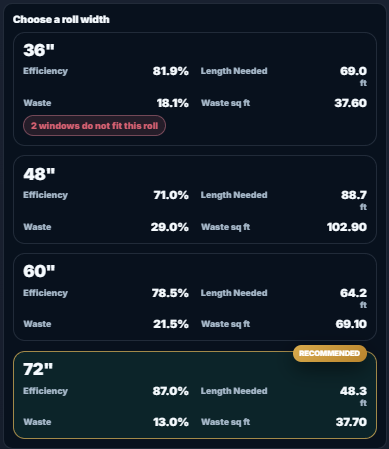
Precision Film Systems lets you enter the window sizes and compare standard roll widths before the job gets too far down the road.
You can see how each roll width affects linear feet, film waste, and the cut layout. That makes it easier to spot when one roll width is clearly better, when two options are close, or when the obvious choice is not actually the cleanest one.
For a solo installer, that can make quoting faster after a measure. For a shop, it can give the person quoting and the person installing a cleaner plan to work from.
Roll width is not the only thing that matters on a flat glass job, but it can change more than people think. The measurements tell you what glass needs film. The roll width helps decide how cleanly that film gets used.
Roll width and flat glass planning
Does roll width really change how much film I need?
Yes. The glass measurements stay the same, but different roll widths can change how the pieces fit, how many linear feet are needed, and how much waste is created.
Is a wider roll always more efficient?
No. A wider roll can be more efficient when pieces fit well side by side, but it can also create waste if the window sizes do not use the extra width cleanly.
Why is linear feet important?
Linear feet tells you how much length comes off the roll. Once you start planning cuts, that number can be just as important as the total square footage of glass.
Should I compare roll widths before quoting?
It helps. You can still quote by square foot, but checking roll-width efficiency before the quote goes out gives you a better idea of the material side of the job.
Does Precision Film Systems choose the roll width for me?
Precision Film Systems compares standard roll widths and shows the material numbers, waste, and cut layout. The installer or shop still decides what makes the most sense for the job.