

Waste is one of those things that every flat glass installer knows exists, but it is not always treated like its own number during the quote.
For a long time, I looked at waste as something that was already built into the price. If I charged enough per square foot, most jobs would be fine. The extra film coming off the roll was just part of doing business.
That way of thinking is not wrong by itself. Most shops have some kind of cushion built into their pricing, whether they call it waste, overhead, margin, or they just know from experience where the price needs to be.
The problem is that waste does not show up evenly on every job.
Some jobs lay out clean. Some do not. Two jobs can have the same square footage, the same film, and the same selling price per square foot, but one of them can use the roll a lot cleaner than the other.
That difference is where waste starts affecting the quote.
Waste is not just scrap on the floor
When people think about waste, they usually think about leftover film after the job is cut.
That is part of it, but it is not the whole picture.
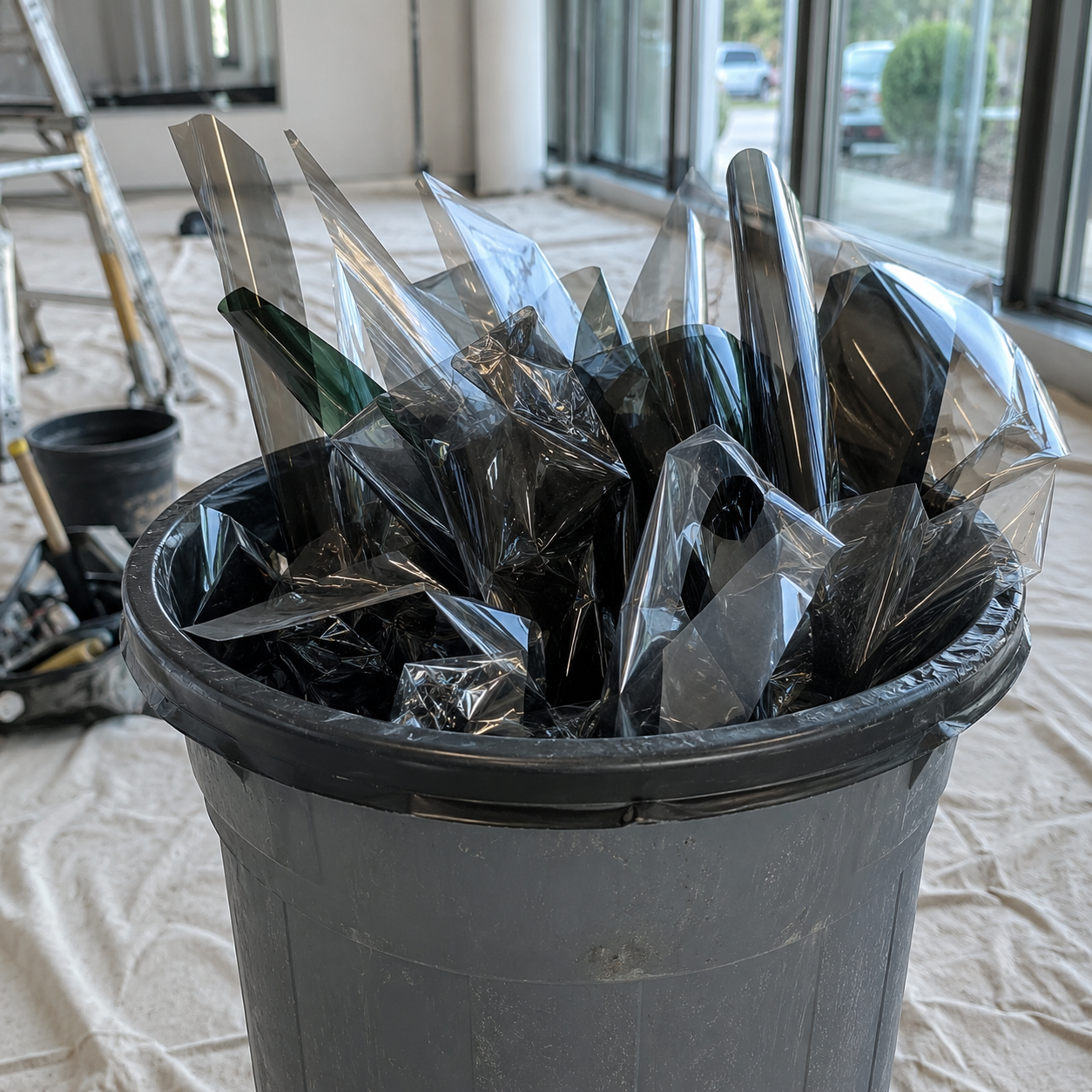
Waste can also come from the way the pieces fit on the roll. A long unused strip down the side of a layout is waste. A roll width that almost works cleanly but leaves awkward offcuts is waste. A layout that needs more linear feet because the pieces cannot be paired well is creating waste before anyone ever touches the glass.
That is why I think waste needs to be looked at during planning, not only after the job is cut.
By the time the film is on the table or in the installer's hands, the quote has usually already been accepted. At that point, the waste is not a pricing question anymore. It is just part of the job.
The square footage price may be covering it
A lot of shops price flat glass in a way that already accounts for waste.
That is normal.
If you have been doing this long enough, you probably know what your square-foot price needs to be so you are not losing money every time a job has some extra material. You may not break waste out as a separate line item, but it is still part of the price somewhere.
The issue is not whether waste is included.
The issue is whether the job creates more waste than your normal pricing expects.
A repeated-size job may fit your pricing perfectly. A house full of odd windows may not. A commercial job with mixed panes, doors, sidelights, and transoms may need a closer look before you assume the standard cushion is enough.
That does not mean every job needs to be overanalyzed. It means some jobs deserve more than a square footage total before the quote is sent.
Roll width can change the waste
This is where waste ties back into roll width.
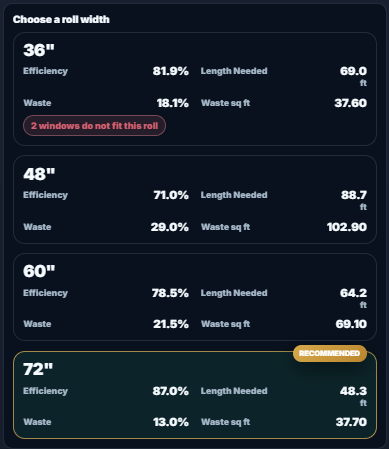
A job might look fine from the measurement list, but once you compare roll widths, one option may create a much cleaner layout than another. A 60-inch roll may let certain pieces sit together well. A 72-inch roll may save linear feet on one job and create more unused width on another.
The total glass area did not change, but the waste did.
That is why it can be risky to assume that a wider roll automatically solves the problem. Sometimes the wider roll is the better choice. Sometimes it just gives you a wider piece of waste.
You do not really know until the pieces are laid out.
That is the part that takes time when planning manually. You are not only looking at whether the windows fit. You are looking at how well they fit together.
Waste affects margin quietly
Waste usually does not feel like a problem when the quote is being written.
The customer sees the price. The job looks good. The square footage seems right. Everything feels normal.
Then later, when the material gets ordered or pulled, the layout is not as clean as expected. Maybe the job needs more linear feet than the square footage made it feel like it should. Maybe the offcuts are not useful for anything else. Maybe the installer has to cut around the layout more carefully than expected.
That is where margin gets thinner.
It is not always a disaster. Most of the time, it is just a small amount of money disappearing from a job that looked stronger on paper.
Enough of those jobs add up.
This is why waste should not only be thought of as leftover material. It is part of the quote, even when the customer never sees it listed that way.
Not all waste is bad
This is an important part.
The goal is not always to get the lowest possible waste number.
Sometimes a little more waste is worth it if the cut plan is cleaner. Sometimes a layout that saves material creates more hassle than it is worth. Sometimes keeping pieces in a certain direction makes more sense for appearance, consistency, or how the installer wants to handle the job.
There is still judgment involved.
A software number should not replace that judgment. It should give the installer or shop a better look at the tradeoff before the decision is made.
Waste is only a problem when it is hidden. If you can see it, you can decide whether it is acceptable.
Quotes are better when the material side is visible
A quote does not need to show every internal planning number to the customer.
Most customers do not care how many linear feet come off the roll or how the cuts are arranged. They care about the price, the film, the work being done, and whether they trust the shop.
But the shop still needs to know what the job is going to take.
That is where a lot of quoting can get cleaner. The customer-facing quote can stay simple, while the internal planning can still show square footage, linear feet, roll width, waste, and the cut layout.
Those numbers help the shop understand the job behind the price.
That is especially useful when the quote gets accepted days or weeks later. Instead of going back to a measurement sheet and trying to rebuild the plan, the material side is already there.
The old way depends on memory and experience
A lot of installers can look at a set of measurements and know when something is going to be annoying.
That experience matters. There is no replacement for it.
But experience still has to be applied somewhere. If the job is being quoted from a quick square footage total, the material side may not get a full look until later. That does not mean the installer missed something. It just means the process pushed that part of the planning farther down the line.
I have done it that way plenty of times.
Measure the job, write down the sizes, talk with the customer, figure the square footage, and get the number together. Then later, when the job is approved, sit down and work through the material side more carefully.
That process works, but it creates a gap between the quote and the actual film plan.
Waste lives in that gap.
Where Precision Film Systems fits
 Start Free Trial
Precision Film Systems helps bring the waste number into the planning process before the quote gets too far along.
You enter the window sizes, compare roll widths, and review the linear feet, film waste, and cut layout. That does not mean the lowest waste option is always the right one, but it gives you something real to look at before deciding.
For a solo installer, that can make it easier to price with more confidence after a measure. For a shop, it can help keep the quoting side and the installation side working from the same information.
Waste is part of flat glass work. It always has been. The point is not to pretend it can be removed completely.
The point is to stop letting it hide inside the quote until later.
Film waste and flat glass quotes
Should film waste be included in a flat glass quote?
Most shops account for waste somewhere in their pricing, even if it is not shown as a separate line item. The important part is knowing whether the job creates more waste than your normal pricing expects.
Is film waste always a bad thing?
No. Some waste is normal, and sometimes a slightly higher waste layout may still be the better choice if it makes the job easier to cut, install, or keep organized.
Can two jobs with the same square footage have different waste?
Yes. The glass square footage can be the same, but the window sizes, roll width, layout, and piece direction can create very different waste numbers.
Does a wider roll reduce waste?
Sometimes. A wider roll can reduce waste when pieces fit well together, but it can also create unused width if the job does not lay out cleanly on that roll.
How does Precision Film Systems help with waste?
Precision Film Systems shows film waste, roll-width comparison, linear feet, and cut layout based on the measurements entered. That helps the installer or shop see the material side before the quote or job plan gets too far along.