
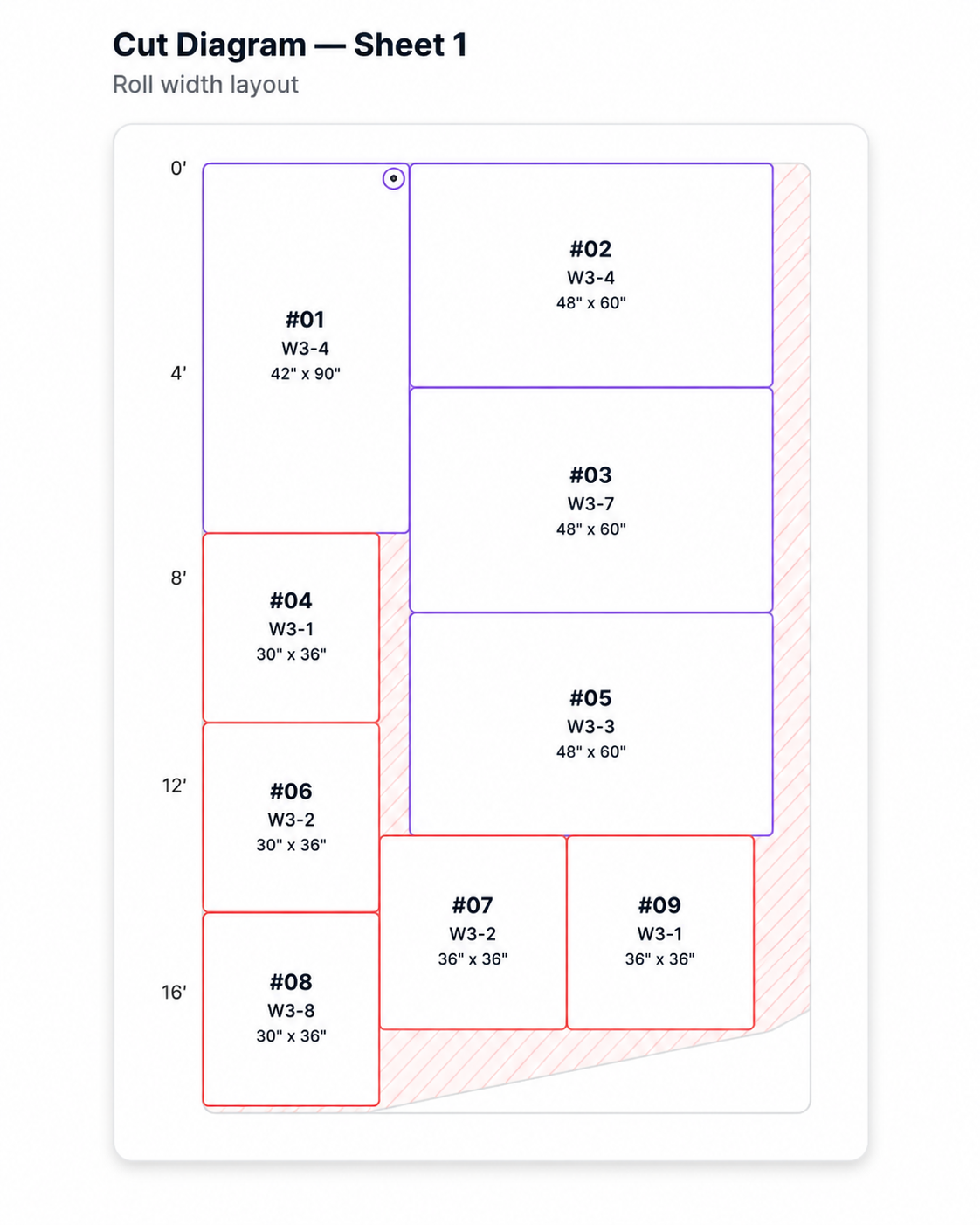
There is a point on every flat glass job where the measurements have to turn into a real plan.
Not just a price. Not just a square footage total. A plan for how the film is actually going to come off the roll.
That step can happen early, while the quote is being put together. Or it can happen later, after the customer has already said yes and the film needs to be ordered or pulled from inventory.
A lot of shops have done it the second way for years. I did too.
Measure the job, get the quote out, wait for the customer to approve it, then come back and figure out the material side when the job becomes real. That process works, but it can leave a gap between the number the customer approved and the way the job actually needs to be cut.
That gap is where the annoying stuff usually shows up.
A quote is not the same as a cut plan
A quote can be built from square footage, film type, difficulty, removal, attachment, travel, and whatever else the shop needs to charge for. It is the customer-facing number.
A cut plan is different.

The cut plan is where the individual window sizes meet the roll. It shows how the pieces fit, how much length is needed, how much film is likely to be wasted, and whether the roll width chosen actually makes sense for the job.
Those two things are connected, but they are not the same.
You can have a quote that looks fine and still have a cut plan that is not as clean as expected. That does not mean the quote was wrong. It means the material side had not fully shown itself yet.
The job looks different once the pieces are laid out
Measurements on paper can make a job look simpler than it is.
A room list might show five windows here, three windows there, a couple doors, a few sidelights, and some odd pieces mixed in. Nothing about that feels unusual when you are writing it down.
Then you start laying the pieces onto a roll width, and the job changes.
Some pieces pair well. Some do not. Some leave long strips of waste. Some force more linear feet than expected. Some make a wider roll look better. Others make the wider roll look good at first and worse once the layout is actually placed.
That is why the cut layout matters. It takes the job out of the measurement list and shows how the material is really going to behave.
The layout can affect more than waste
Waste is usually the first thing people think about when they hear "cut plan," but it is not the only reason to plan the layout.
A good cut plan can also make the job easier to organize.
If the pieces are grouped in a way that makes sense for the installer, the job can move cleaner in the field. Room by room, elevation by elevation, or section by section, depending on how the work is being handled. That can matter just as much as saving a little material.
A layout that saves film but makes the job harder to follow may not be the best layout. Sometimes the cleanest plan is the one that balances material use with how the installer is actually going to work.
That is the part a simple square footage number will never show.
Pulling film without a plan can create extra work
Pulling film is not hard by itself.
The extra work comes from doing it before the layout is clear.
If the roll width has not been checked, the linear feet are still a guess. If the pieces have not been laid out, the waste is still hiding. If the job has mixed sizes, someone may have to stop and figure out the best way to cut before anything moves forward.
That might only take a few minutes on a small job. On a larger job, it can slow the whole process down.
It can also create second guessing. Should this have been ordered in another width? Could these pieces have paired better? Is this offcut useful, or is it just going to sit around until it gets thrown away?
Those are not questions you want to be answering for the first time when the job is already approved and ready to be installed.
A cut plan helps the quote hold up better
When the cut layout is planned before the quote gets too far along, the quote has better information behind it.
That does not mean the customer needs to see the whole internal layout. Most customers do not care how the pieces are arranged on the roll. They care about the work being done, the film being used, the final price, and whether the shop seems professional.
But the shop should know what is behind that price.
If the cut plan shows that the job lays out clean, that is good to know. If it shows more waste than expected, that is also good to know. If two roll widths are close but one makes the install plan cleaner, that becomes a decision instead of a surprise.
That is the real value of looking at the layout early.
It makes the quote less disconnected from the job that will actually get installed.
The old way depends on rebuilding the job later
One of the frustrating parts of manual planning is that the job often gets figured out more than once.
You measure it once. You write it down once. You quote it once. Then when it gets approved, you may have to pull the notes back out and rebuild the material plan from the same measurements again.
That is not always a big deal. On simple jobs, it may be quick.
But when the job has enough pieces, enough rooms, or enough odd sizes, rebuilding the plan later takes time. It also gives you another chance to miss something, forget why you wrote a note a certain way, or lose the context you had while you were standing in front of the glass.
That is one reason I like connecting the cut plan to the measurements earlier in the process. The job is fresher, the layout is already there, and the material plan does not have to be recreated from scratch later.
The cut plan is not just for the person quoting
In a one-person operation, the person measuring, quoting, ordering, cutting, and installing may all be the same person. Even then, a cut plan helps because it gives you something to come back to when the job moves forward.
In a shop, it matters even more.
The person who measures or quotes the job may not be the person cutting the film. The installer may not have been there when the customer walked through the options. The job may sit for a week before it gets scheduled.
A cut plan helps carry the job information from one step to the next.
It gives the shop a cleaner handoff. Not perfect, not automatic, and not a replacement for communication, but better than sending a quote forward with the material side still half in someone's head.
Planning early does not mean overcomplicating the job
There is a balance here.
Not every flat glass job needs to be treated like a giant commercial project. Some jobs are simple. Some measurements repeat. Some layouts are obvious.
The point is not to turn every quote into a full production meeting.
The point is to avoid pushing the material plan so far down the line that it becomes an afterthought. Even a quick look at the layout can tell you whether the job is clean, awkward, waste-heavy, or worth checking against another roll width.
That kind of information is useful before the quote is approved, not only after.
Where Precision Film Systems fits
 Start Free Trial
Precision Film Systems is built to make this part faster.
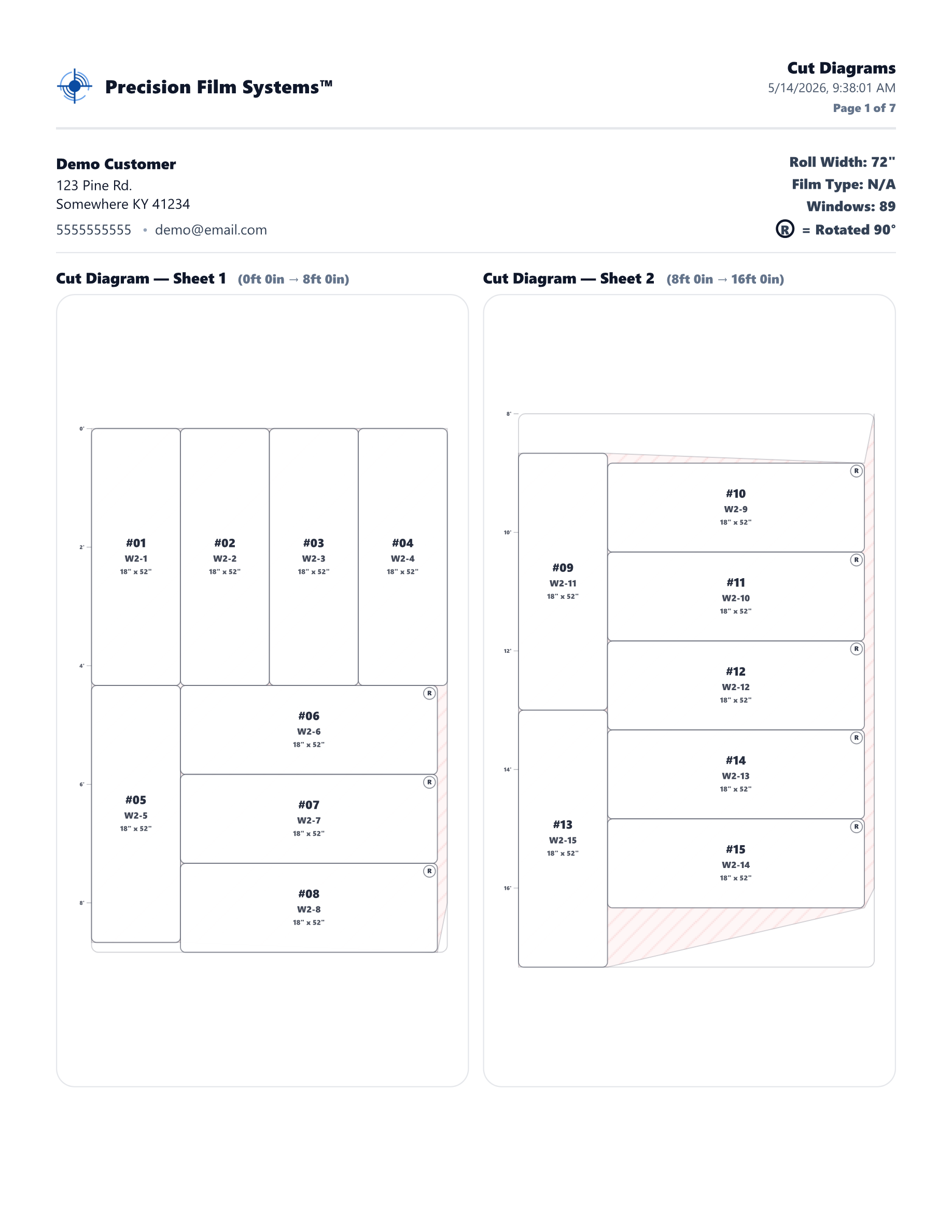
You enter the window sizes, compare standard roll widths, and review the cut layout, linear feet, and film waste before the job gets too far along. The installer or shop still makes the final call. The software just makes the material side easier to see.
That can help during quoting, ordering, pulling film, and handing work off inside the shop.
A cut plan will not make every job perfect. It will not remove every offcut or replace the judgment that comes from experience. But it can keep the material side from being something you only deal with after the customer has already approved the quote.
The measurements tell you what glass needs film. The cut layout shows how to cut the film from the roll to fit that glass.
Cut layouts and flat glass planning
What is a flat glass cut layout?
A cut layout, or Cut Diagram, shows how the measured window pieces fit onto a selected roll width. Without a cut layout, the metrics you see on the roll comparisons are not very useful.
Should I plan the cut layout before quoting?
It helps. The customer does not need to see every internal planning detail, but checking the layout before the quote goes out can give the shop a better understanding of material needed, waste, and roll-width efficiency.
Does a cut plan always need to use the lowest waste option?
No. The lowest waste option is not always the best job plan. Sometimes a slightly higher waste layout may be easier to cut, easier to organize, or better for how the installer wants to work.
Why does the cut plan matter if I already know the square footage?
Square footage tells you the glass area. The cut plan shows how the individual pieces fit on the roll. Those are related, but they are not the same thing.
How does Precision Film Systems help with cut planning?
Precision Film Systems uses the entered measurements to compare roll widths and show cut layout, linear feet, and film waste. That gives the installer or shop a clearer material plan before the job gets too far along.