
For a long time, my thinking was pretty simple.
Measure the glass, get the square footage, and make sure I was charging enough per square foot to cover the waste. On a lot of jobs, that worked fine. I had enough built into the price that I was not worried about every extra piece of film coming off the roll.
But flat glass does not always stay that clean.

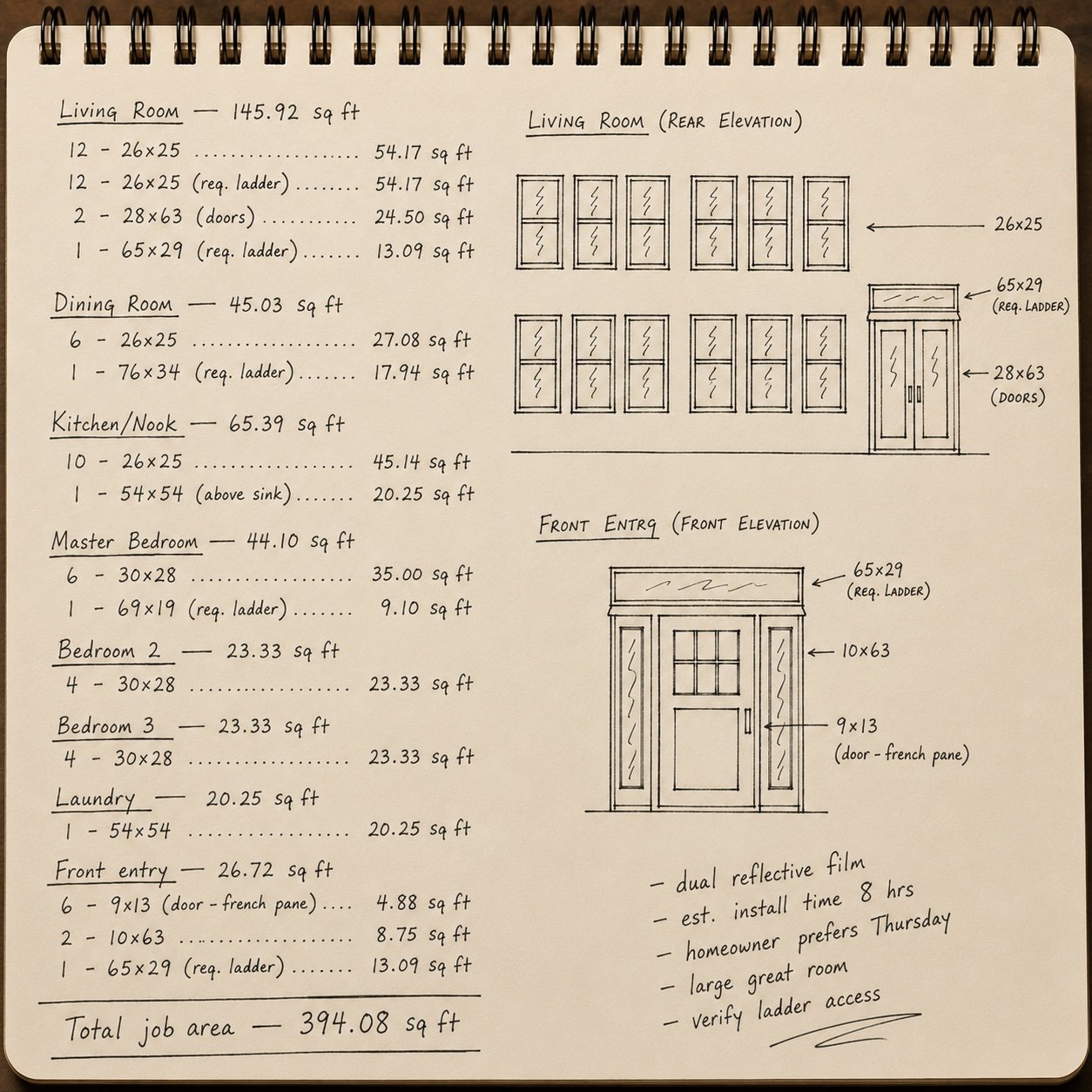
The square footage number is easy to understand. If the job has 280 square feet of glass, everybody knows what that means. It gives you something solid to price from and it makes the job feel easier to compare against the last one.
The problem is that the roll does not lay out based on the total. It lays out based on the individual pieces.
That is where the difference starts showing up.
The glass number is only the starting point
Square footage still matters. You need it for pricing, for understanding the size of the job, and for having a baseline before you get into the material side. I am not arguing against measuring square footage.
I am saying square footage is the glass number. It tells you what is getting covered, but it does not automatically tell you what the job is going to take from the roll.
That matters more once the job gets away from simple repeated sizes. Doors, sidelights, transoms, tall panes, mixed rooms, and oddball measurements can all change how cleanly the job lays out. A measurement sheet may look simple when you leave the house or building, but the roll layout can tell a different story later.
Roll width is where the job changes
Two jobs can have the same total square footage and need different amounts of film.
One job might lay out clean on a 60-inch roll. Another might leave a long strip of waste running down the side. A wider roll might let you pair pieces together and save material. Or it might look better at first, then waste more once the pieces are actually placed.
That is why I do not like treating square footage as the whole job. It is an important number, but it is not the material plan.
The better question is not only, "How much glass am I covering?" It is, "Which roll width makes this job make the most sense?"
That is the part that takes time when you are doing it with notes, calculators, sketches, or memory.
This is where margin can quietly disappear
Most installers have some way they account for waste. Some add a percentage. Some price high enough that most jobs are covered. Some can look at a set of measurements and get close because they have done enough of this work to know what is probably coming.
There is nothing wrong with that. I did plenty of it that way.
The issue is that "close enough" does not mean the same thing on every job. A normal residential job with repeated window sizes may be forgiving. A commercial job with a pile of different panes may not be. A few pieces that do not pair well on the roll can change the material number without changing the glass number at all.
That is the part that can sneak up on you. The quote goes out based on square footage, the customer accepts, and then later the material side gets a closer look. Sometimes the difference is small enough that it does not matter. Other times, the job looked better when it was still just a number on the quote.
Linear feet matters
A lot of flat glass quoting conversations stay focused on square footage, but once you are actually planning the film, linear feet becomes just as important.
You may know how much glass is being covered, but you still need to know how much length comes off the roll. That is where roll width, piece direction, and layout all start working together.
A 48-inch roll and a 72-inch roll can give you very different answers on the same job. The measurements did not change. The film did not change. The layout changed.
That is why I think the material side needs to be looked at before the quote gets too far ahead of the actual plan.
The old way still works
There is a reason a lot of shops still do this with paper, calculators, sketches, and experience. It works.
I did it that way too. Go measure the job. Write down the sizes. Maybe sketch the rooms or window locations. Talk through film options with the customer. Then either figure the job while standing there, from the truck, or later back at the shop.
This was just the process that needed to be done. It is just slower than it needs to be, especially when the job has enough sizes that you have to start testing roll widths in your head.
The measuring is usually not the part that slows everything down. The slower part is turning those measurements into a roll-width decision, a film-needed number, and a cut plan you can actually use.
A better way to look at it
I think it helps to separate the numbers instead of forcing everything into one square footage total.
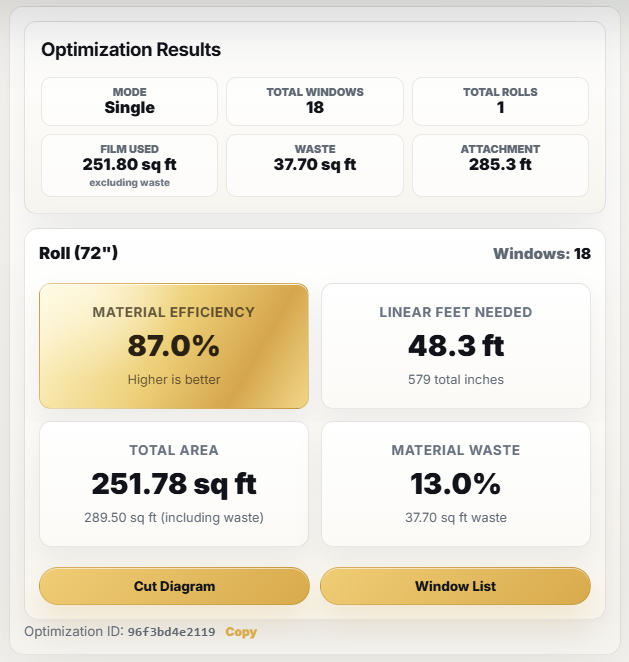
Glass square footage tells you what is getting covered. Film needed tells you what the job is likely to take from the roll. Waste tells you what gets paid for but does not end up on the glass. Linear feet tells you how much roll length the layout requires.
Those numbers are connected, but they are not interchangeable.
When they all get treated like the same thing, the quote may be easier to build up front, but the material side is not as clear later. When you separate them, the quote has a better chance of matching the job that actually gets installed.
Where Precision Film Systems fits
 Start Free Trial
Precision Film Systems was built around this part of the process.
It is not there to teach installers how to measure windows. The measurements still come from the person doing the job. The value is in taking those measurements and quickly comparing standard roll widths, linear feet, film waste, and the cut plan before the job gets too far along.
That gives you a better look at the material side before the customer says yes. It also gives you something cleaner to come back to when the job is approved and it is time to order film, pull material, or hand the work off.
Square footage is still part of the job. It just should not be carrying the whole material plan by itself.
Square footage vs. film needed
Is measured square footage the same as film needed?
No. Measured square footage is the glass area receiving film. Film needed depends on how those pieces fit on the roll, which roll width is used, and how much waste the layout creates.
Can a job need more film than the glass square footage?
Yes. That is common. Film comes off a roll, so the layout may require more material than the actual glass area.
Why does roll width matter so much?
Roll width affects how pieces fit side by side, how much length comes off the roll, and how much waste is created. The same job can look different on different roll widths.
Should I still price by square foot?
Many shops do. Square-foot pricing can still work, but it helps to know the material side before relying on that number too heavily.
Does Precision Film Systems replace estimating software?
No. Precision Film Systems is not a full estimating, CRM, or invoicing system. It does include tools that support estimates and quotes by helping you see roll width, linear feet, film waste, material usage, and job-ready output.